
How to unblock blocked websites
Here's how to unblock blocked websites safely using Google Translate, custom DNS, a VPN, Tor Browser, or Firefox's built-in VPN.
The internet is full of free web proxies that promise to unblock anything, but many log your browsing data or serve ads. You don't need one of those. The methods on this page work without a third-party service.
Many regional firewalls, schools, and workplaces restrict access to major web platforms. The most commonly blocked sites: Google, Facebook, YouTube, X (Twitter), Instagram, Reddit, Pinterest, Discord, Twitch, TikTok, and Wikipedia.
A blocked website doesn't always show a warning page. You'll often just see a standard error like This site can't be reached, Hmmm...can't reach this page, or Hmm. We're having trouble finding that site. We can't connect to the server at [domain]. On network firewalls or managed accounts, you will often see messages like DENIED, ACCESS DENIED, or ERR_BLOCKED_BY_ADMINISTRATOR.
Privacy warning: Don't log into bank accounts or enter sensitive credentials while using public unblocking methods. For full privacy, use a VPN or Tor.
Method 1: Unblock websites with Google Translate
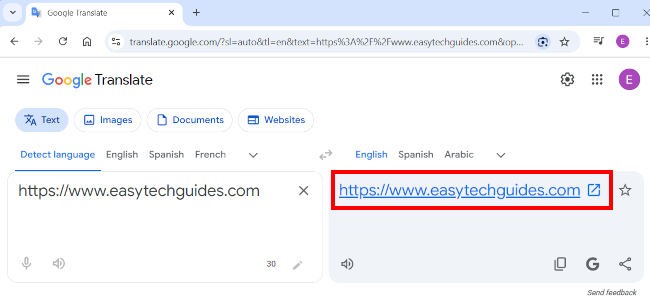
If you're on a restricted computer (library, school PC) where you can't change settings or install software, Google Translate works as a free proxy. The traffic goes to Google's servers, which fetch the page for you, so the network filter only sees a connection to Google.
- Go to translate.google.com.
- Paste the URL of the blocked site in the left text box (e.g., https://example.com).
- Click the link that appears in the right text box.
- The page loads inside Google's translation interface.
Method 2: How to unblock websites using Secure DNS settings
Many basic network filters—including home router parental controls and ISP blocks—work by intercepting DNS requests. When you try to visit a blocked site, the filter's DNS server resolves the domain to a block page instead of the real site. Switching to a public DNS like Cloudflare bypasses this.
Windows 11 setup
- Right-click the Windows start menu button and click Settings, or press the Windows + I keys to open settings.
- In the Settings window, click on Network & internet in the left-hand sidebar menu.
- Click on your active network connection type at the top of the menu (either Wi-Fi or Ethernet).
- Click Hardware properties.
- Click Edit next to DNS server assignment.
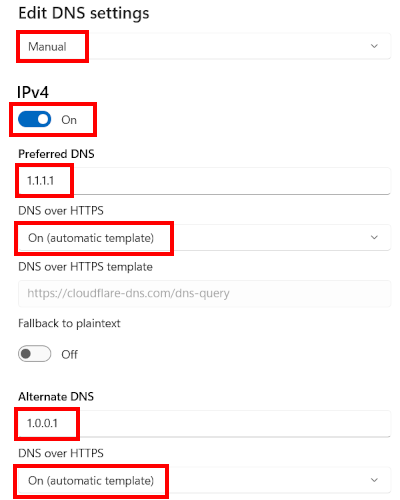
- Change the top dropdown selection from Automatic (DHCP) to Manual.
- Toggle the IPv4 switch to the On position.
- In the Preferred DNS text field, type 1.1.1.1 (Cloudflare).
- Select On (automatic template) at DNS over HTTPS.
- In the Alternate DNS field, type 1.0.0.1.
- Select On (automatic template) at DNS over HTTPS.
- Click Save.
Your DNS lookups will now go through Cloudflare instead of your provider's filter.
Android setup (phones & tablets)
Android has a built-in setting called Private DNS. This routes your DNS lookups over an encrypted connection (DNS over TLS), so local network filters can't intercept or redirect your lookups.
- Open your Android device's settings.
- Tap Network & internet or Connections.
- Tap Private DNS. If you don't see the Private DNS option, you may have to tap on More connection settings or Advanced.
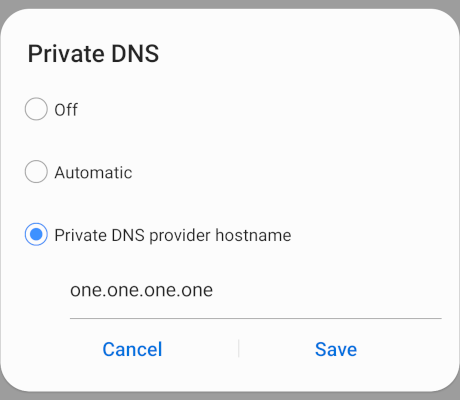
- Select Private DNS provider hostname.
- In the 'Private DNS' input field, type one of these: one.one.one.one (Cloudflare) or 1dot1dot1dot1.cloudflare-dns.com.
- Tap Save.
Your DNS lookups now go through Cloudflare instead of your network's DNS.
Note for legacy devices: If you're on Android 8.0 or earlier, the Private DNS option won't be in your settings. Download the free 1.1.1.1 app from the Google Play Store instead. It configures the connection automatically.
Browser-level setup (no administrator rights needed)
If you are using a restricted school or work computer where the Windows Settings app is locked down, you cannot change your system-wide DNS. Fortunately, you can enable DNS over HTTPS (DoH) directly inside your web browser. This encrypts your DNS lookups inside the browser, so it works even when system settings are locked.
Chrome, Edge & Brave
The steps are the same for all three.
- Click the three-dot menu button (Chrome/Edge) or three-line menu button (Brave) in the top right corner.
- Click Settings.
- Click Privacy and security (Chrome/Brave) or Privacy, search, and services (Edge) in the left menu.
- Click Security.
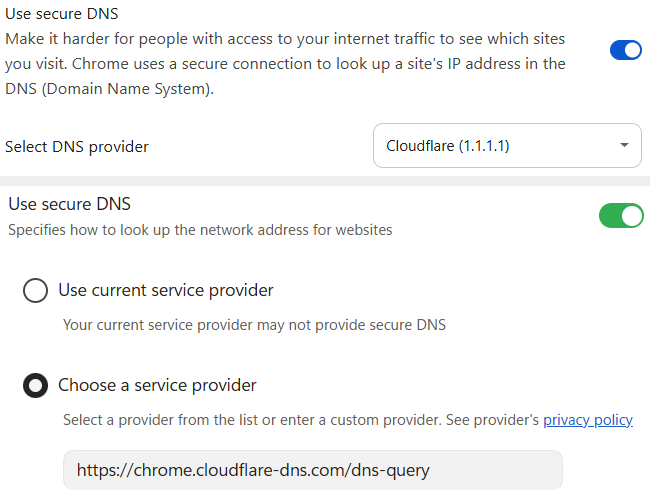
- Ensure the Secure DNS option is enabled.
- Click the dropdown menu next to Select DNS provider (Chrome/Brave) or select Choose a service provider (Edge).
- Choose Cloudflare (1.1.1.1) from the list.
Mozilla Firefox
- Click the menu button in the top right corner.
- Click Settings.
- Click Privacy and security in the left menu.
- Scroll down to the DNS over HTTPS section.
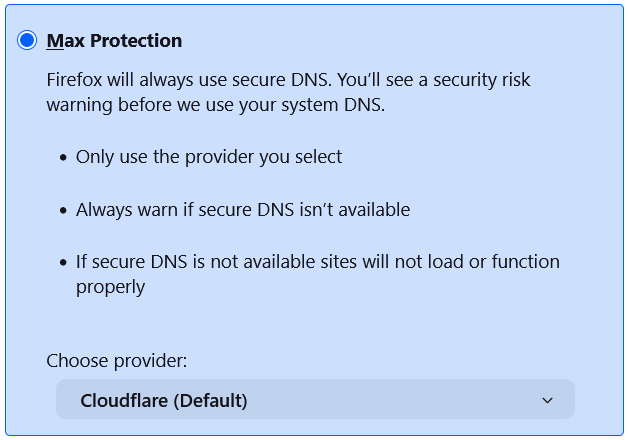
- Change your protection level to Increased Protection or Max Protection.
- Ensure the Choose provider dropdown menu is set to Cloudflare.
Method 3: Bypass network blocks with a secure VPN
If you need to bypass a firewall that inspects your traffic, a VPN is required. A VPN creates a encrypted tunnel between your PC and a remote server. Avoid free VPN browser extensions and stick to a zero-logs provider.
- Open your browser, go to the official website of ProtonVPN, and register for their free tier (unlimited bandwidth, no ads).
- Download and install the native client application for your device.
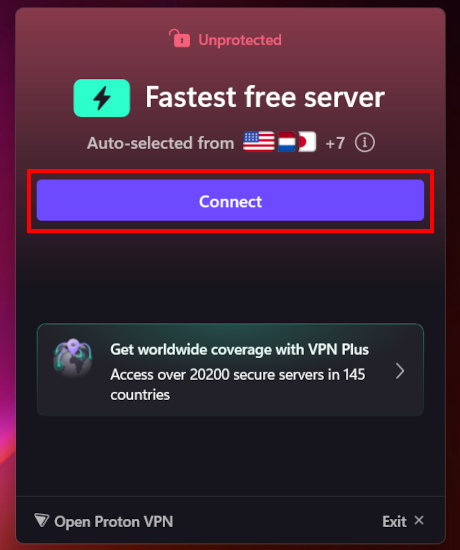
- Launch the application and click the Connect button.
- It connects you to a server. Once connected, all blocked websites will open normally.
Premium VPN alternatives for better speeds and more server locations
Free tiers work fine for browsing, but servers can get crowded and slow during peak hours. If you need more speed or server locations:
- Mullvad – No email or account needed.
- IVPN – Open-source, independently audited.
- Cryptostorm – Token-based, no account needed. For advanced users.
Method 4: Use Tor Browser to unblock sites
If a firewall blocks standard VPN protocols, Tor Browser routes your traffic through three volunteer relay servers, which bypasses both the block and any local tracking.
- Download Tor Browser from the Tor Project website.
- Install and open it.
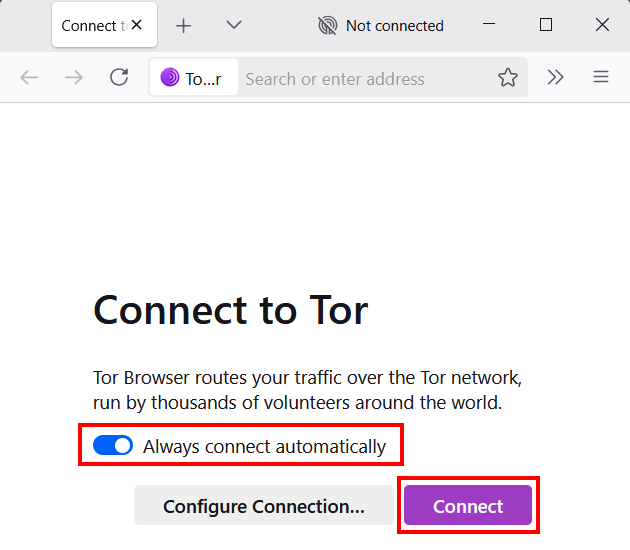
- Enable Always connect automatically.
- Click Connect.
Note on Tails: If you need a fully amnesic environment (nothing written to disk), the Tor Project also makes Tails OS, which boots from a USB stick. For most filtering issues, Tor Browser alone is enough.
Tor is slower than a normal browser because of the relay hops. Use it for reading and basic web tasks, not video streaming.
Method 5: Use Firefox's built-in VPN
Firefox includes a built-in VPN that hides your IP and bypasses blocked sites. You get 50 GB per month free.
Note: Only protects traffic inside the browser, not your entire device.
On a computer:
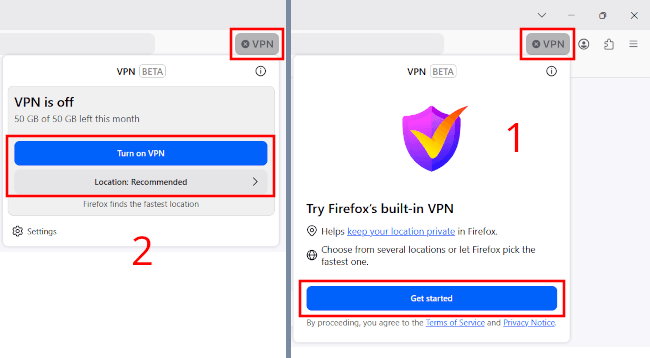
- Click the VPN icon in the top-right corner, then click Get started.
- Log in to your Mozilla account, or create one.
- Click the VPN icon again, then click Turn on VPN.
- Choose a location, or let Firefox pick the fastest one.
On Android:
- Tap the three-dot menu button, then tap Settings.
- Tap Built-in VPN.
- Tap Get started.
- Log in to your Mozilla account, or create one.
- The VPN turns on after you log in. If not, tap the toggle next to VPN.
- Choose a location, or let Firefox pick the fastest one.
Outdated methods to unblock blocked websites
Older guides recommend the following methods, but they no longer work on most current firewalls:
| Method | What it did | Why it fails today |
|---|---|---|
| Using the IP address | Entering a website's numeric IP address instead of its domain name. | Modern firewalls use SNI filtering to inspect the hostname during the connection handshake, blocking it anyway. |
| URL shorteners | Hiding a blocked link behind a shortener domain. | Filters either follow the redirect and block the target, or block the shortener domain outright. |
| Free web proxies | Loading a site through a public proxy page. | Firewalls use automated category filtering to block proxy portals. Most free proxies also log user data and inject adware. |
Related:
How to enable DNS over HTTPS in Windows 11 (step by step)
How to use Private DNS on an Android phone or tablet
How to set up DNS on any Android phone or tablet
How to access blocked websites on Android (6 safe methods)
How to block a website in Windows 10 and 11 (step by step)
Block websites with NextDNS: Chrome, Edge, Brave & Firefox