
How to fix the "file is too large for the destination file system" error
This error means your USB drive uses FAT32, which can't store files larger than 4 GB. Fix it by reformatting the drive to NTFS or exFAT.
Warning: Back up any files on the USB drive before you start. Formatting erases everything on it.
How to fix: The file is too large for the destination file system
- Connect the USB flash drive to your computer.
- Open File Explorer.
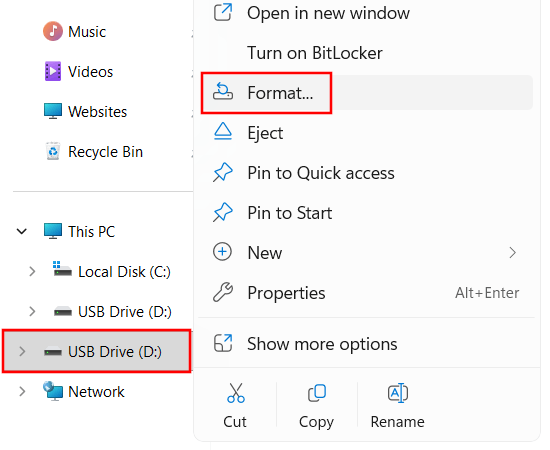
- In File Explorer, right-click the USB drive under This PC.
-
Click Format.
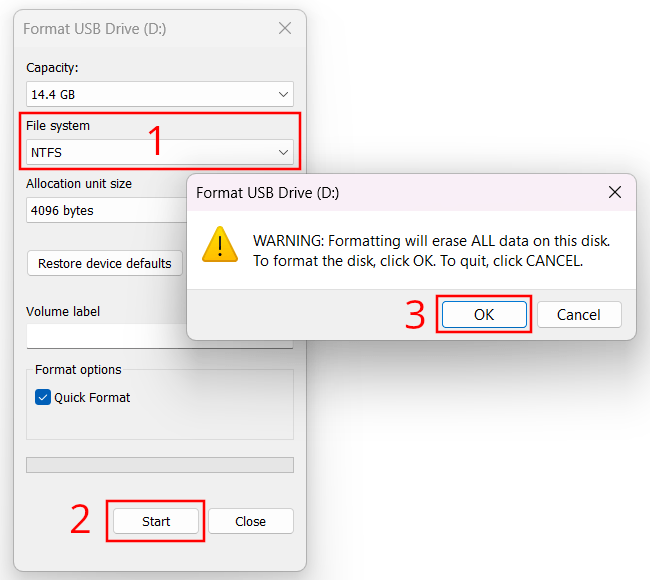
- Select NTFS (Windows only) or exFAT (Windows and Mac) from the File system dropdown.
- Click Start.
-
A warning appears. Click OK to erase all data and continue.
- The drive formats. When "Format complete" appears, click OK.
- Click Close.
Copy the file to the USB drive.
Alternative: Convert without erasing files
If you can't erase the drive, you can change its file system while keeping your data. This only works if the drive is currently FAT32. It won't work on exFAT.
Back up any important files first. If the drive is unplugged mid-conversion, data can be lost.
Open Command Prompt as an administrator and type:
convert X: /fs:ntfsReplace X: with your USB drive's letter (check This PC to find it).
Note: This only converts to NTFS. You can't convert back to FAT32 without reformatting.
Related:
Fix: Problem Ejecting USB Mass Storage Device on Windows 10 & 11
USB flash drive showing less space than actual? Here's a fix!
Fix: 'This folder is empty' on a USB drive on Windows 10 & 11